
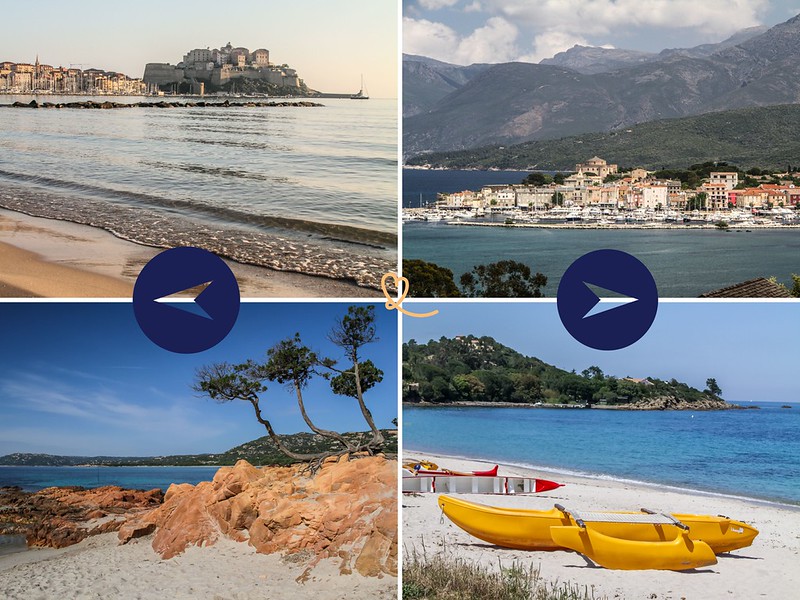
Heavenly beaches, hilltop villages, spectacular mountains and a rugged coastline… Corsica offers incredible diversity. But as the island is quite large, where should you spend your vacation: East or West Corsica?
Here are all our reviews and comparisons, with photos, to help you choose according to your preferences and experience an unforgettable trip to Corsica!
If you’re hesitating between north and south, see our other dedicated article.
This opinion is completely independent, based on our experiences. We visited the region anonymously, making our own choices and paying all our bills in full.
East or West Corsica? Summary
A geographical concept – let’s clarify the terms
Before we compare, let’s clarify what we mean by East and West Corsica in this article.
The separation generally follows the central mountain range that crosses the island from north to south.
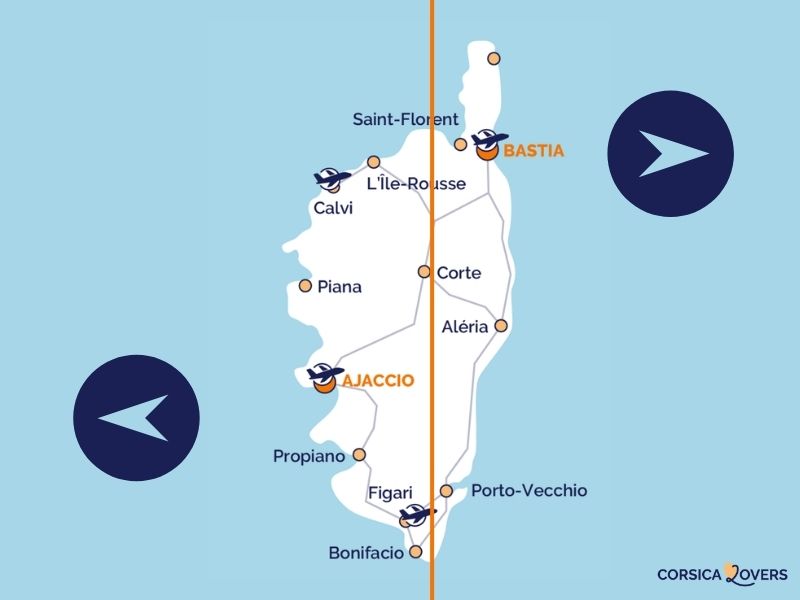
In western Corsica, you’ll find the towns of Calvi, L’Île-Rousse, Porto, Ajaccio and Propriano.
To the east, you’ll find Bastia, Saint-Florent, Aléria, Solenzara and Porto-Vecchio. Bonifacio is located at the southern tip of the island and can be accessed from both sides.
See the cars and offers available on our favorite platform.
East or West Corsica – the battle
In this article, we go into the details of the comparison for several criteria with photos. But here is a summary of our opinions:
- Most spectacular landscapes = West Corsica
- Most beautiful villages = West Corsica
- Historical and cultural sites = equality
- Ease of driving = East Corsica
- Nature activities = equality
- Cities = West Corsica
- Peace and quiet = East Corsica

Where to stay?
At the end of the article, you’ll find our tips for choosing where to sleep in each region. But if you already have an idea, we recommend:
To the west
- Calvi – see the best rated accommodations
- L’Île-Rousse – see the best rated accommodations
- Ajaccio – see the best rated accommodations
To the east
- Porto-Vecchio – see the best rated accommodations
- Bastia – see the best rated accommodations
- Saint-Florent – see the best rated accommodations
Where to read our article on where to sleep in Corsica.

East or West coast Corsica: natural landscapes
Both coasts offer remarkable natural beauty, but with very distinct characters.
The west coast is renowned for its spectacular scenery and wilderness, while the east coast boasts a varied coastline and unspoilt coves.
Examples of natural sites on the West Coast
The calanques de Piana and the Scandola reserve

This Unesco World Heritage site is one of Corsica’s most impressive landscapes. Red granite cliffs plunge into a deep blue sea. Depending on the light, the rocks take on orange or pink hues. You can drive along the corniche or go hiking to discover these exceptional geological formations.
We love driving this road in the late afternoon, when the sun brings out the warm colors of the rock.
See more photos or Book your boat tour directly
The cliffs of Bonifacio

Bonifacio is one of the most fascinating places in Corsica. A must in our opinion!
The place combines nature, history and architecture.
The citadel is built on a peninsula surrounded by impressive white cliffs sculpted by erosion.
It’s a unique place!
See our article on Bonifacio
Examples of natural sites on the East Coast
Cap Corse

The east coast of Cap Corse offers a jagged coastline with pebbly beaches and secluded coves. The mountains plunge straight into the sea. We love the small, unspoilt fishing ports like Erbalunga and Macinaggio. The coastal road offers constant views of the sea with plunging mountains.
Read more about it.
Solenzara Gorge

The Gorges de Solenzara are one of the most beautiful mountain roads on the east coast. From the coastal village of Solenzara on the east coast, the D268 winds its way up the river through a spectacular canyon. The rock faces narrow in places, creating impressive passages. The road runs alongside emerald pools where many visitors stop for a swim in summer.
East or West Corsica: where are the best beaches?
Both coasts have superb beaches, but with different characteristics.
The west coast offers a wide variety of beaches, often with spectacular rock formations.
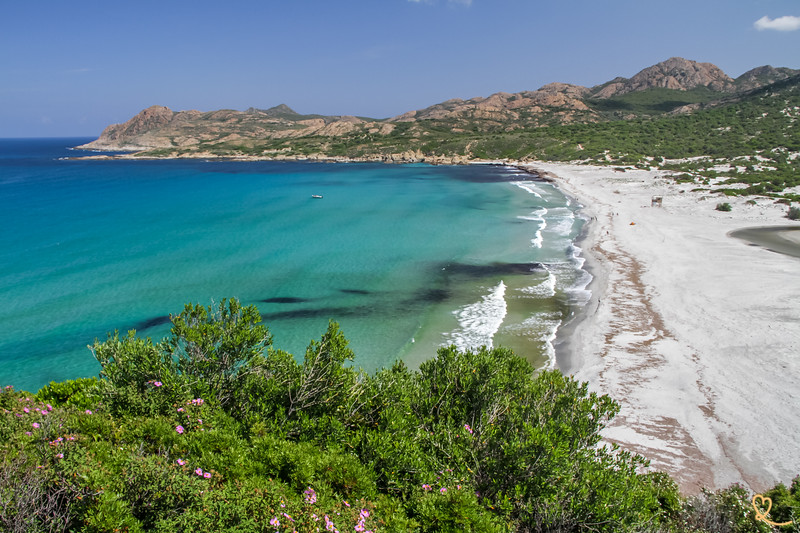
The east coast offers beautiful sandy coves in the south and long sandy beaches in the central east, with much more peace and quiet.
Examples of West Coast beaches
Palombaggia Beach

To the south-west, Palombaggia regularly features in rankings of Europe’s most beautiful beaches. We understand why. The umbrella pines leaning over the white sand create a unique atmosphere. The red rocks separating the various coves invite exploration and offer great snorkeling opportunities. The shallow turquoise waters are perfect for families. In high season, traffic can be heavy, so opt for the early hours.
See more photos
Beach of Verghia

Closer to Ajaccio, we fell in love with Verghia. Its neighboring beach is actually more famous (Mare e Sol, sometimes called the Silver Beach), but we have a clear preference for Verghia. We love this rock formation! It’s so photogenic.
Balagne beaches: for example Plage de la sainte Restitude

Between Calvi and Lumio, the beach of Sainte-Restitude offers a relaxing setting far from the constructions.
The sandy beach is a happy cove with rocks for those who prefer. And it faces the citadel of Calvi, offering beautiful views, with the mountains in the background.
The descent into the water is gentle and the beach is only 150m long. It is an ideal place with children.
See the most beautiful beaches around Calvi.
Examples of East Coast beaches
Beach of Favone

In the south-east, it’s definitely our first choice for swimming. The sand and water were perfect. Not many mountains for a view, but perfect for relaxing and floating in the water.
See more photos
Around Aléria

Further north, the coast is flatter and more agricultural. The beaches are long, flat and much quieter.
Here the sand is white and you can enjoy long walks with your feet in the water.
Around Bastia

If you want to enjoy a swim in the heart of Bastia, downtown beaches such as Toga or Ficaghjola offer convenient and easily accessible options. For an afternoon of absolute relaxation, opt for more outlying beaches such as Arinella, Furiani or Mariana, where long stretches of fine sand and suitable facilities will ensure your idleness.
See the most beautiful beaches in Bastia.
Where is the water warmest: East or West?
Water temperature varies little between the two coasts. Local conditions play a more important role: beach orientation, bay protection, depth.
Average temperatures are:
- May: 18 to 19°C
- June: 21 to 23°C
- July: 22 to 24°C
- August: 23 to 25°C
- September: 22 to 24°C
- October: 20 to 21°C
Protected bays such as Santa Giulia to the east or the Gulf of Sagone to the west can offer slightly warmer water thanks to their shallower depths.

East or West Corsica: the villages
Both coasts are home to remarkable villages, each with its own character.
The Balagne region in the west is home to a high density of hilltop villages, while the east offers unspoilt coastal villages and mountain towns.
See our article on Corsica’s most beautiful villages.
West coast villages

Balagne lives up to its nickname of “Corsica’s garden”. This fertile region is home to many artisan villages:
- Pigna with its characteristic blue shutters. The cobbled streets are home to artisans’ workshops and galleries. We love the creative atmosphere in this lovingly restored village.
- Sant’Antonino is one of Corsica’s oldest villages. Perched on its rocky peak, it dominates the plain. Stone houses blend into the rock. The view from the summit embraces the entire coastline.
- Speloncato clings to the mountain with its granite houses. The village offers panoramic views over the valley and the sea. The narrow streets invite you to stroll.
East coast villages

The east coast offers a beautiful variety of villages:
- Erbalunga on Cap Corse, with its charming little fishing port and Genoese tower. The colorful houses are reflected in the water. We like to sit on the terrace and watch the bustle of the port.
- Nonza dominates the west coast of Cap Corse from its rocky outcrop. The Paoline tower offers spectacular views. Below, the grey pebble beach contrasts with the green scrubland.
- Vescovato in the Castagniccia region retains its old-fashioned atmosphere. Tall houses line narrow streets. The baroque church is well worth a visit.
Subscribe to our Newsletter
- Get away from it all with Region Lovers’ beautiful destinations!
- Once a month
- Advertising-free
East or West Corsica: historical and cultural sites
Both coasts boast a rich historical heritage, with specific features for each region.
Genoese towers dot the entire Corsican coastline, but some sites are unique to each coastline.
See our articles:
Prehistoric sites
Museums in Corsica
West coast sites

The west coast is home to several remarkable sites:
- Calvi’s citadel dominates the port from its promontory. The 15th-century Genoese ramparts surround the upper town. We enjoy strolling through its cobbled streets. The view from the ramparts embraces the entire bay.
- The prehistoric site of Filitosa in the Taravo valley boasts some fascinating statue-menhirs. These granite sculptures date back to 3500 BC. The site combines dolmens, menhirs and habitat remains. The museum completes the visit with detailed explanations.
- The Parata tower near Ajaccio offers a spectacular setting. Perched on its rocky islet, it watches over the Îles Sanguinaires. The path leads through scrubland, with constant sea views.
- Ajaccio’s museums on Bonaparte
East coast sites

The east coast is home to many reminders of the past:
- TheAléria preserves the remains of Corsica’s ancient Roman capital. Excavations have revealed the forum, thermal baths and dwellings. The museum housed in Fort Matra displays the objects discovered during the excavations. The collection includes Greek ceramics, amphorae and jewelry.
- The Pisan churches of the eastern plain bear witness to the period of Pisan domination in the 11th and 12th centuries. San Michele de Murato to the north and La Canonica near Bastia feature remarkable Romanesque architecture with their two-tone decor.
- Bastia’s palace and museums
East or West Corsica: driving
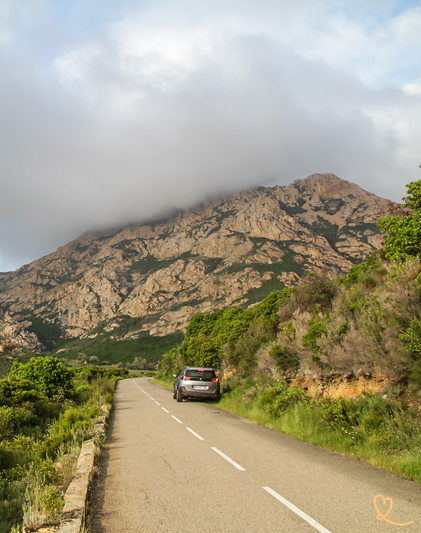
Driving conditions differ significantly between the two coasts.
This difference may influence your choice, depending on your experience of mountain driving and your apprehension of winding roads.
Driving on the West Coast

The west coast offers spectacular but demanding roads. The D81 along the Gulf of Porto is one of Corsica’s most beautiful roads. One hairpin bend follows another between sea and mountains. The calanques de Piana require constant attention when driving. The road is narrow in places and crossing with buses can be tricky. We advise you to take your time and enjoy the many viewpoints.
The route between Porto and Calvi via the Scala di Santa Regina crosses some impressive gorges, with some ledge passages. Allow at least 2h30 to cover the 75km.
Points to note for the west coast:
- Winding roads with many hairpin bends
- Narrow portions requiring vigilance
- Journey times to be multiplied by 2 in relation to distances
- Spectacular landscapes worth the detour
Driving on the East Coast

The east coast offers generally easier driving conditions. The N198 along the coast is well-maintained and relatively wide. There are more straight sections, making for a smoother ride. Journey times are more in line with advertised distances. From Porto-Vecchio to Bastia, you’ll cover around 140km in 2h15.
The only exception: the road to the Aiguilles de Bavella from Solenzara winds its way up through the gorges. This section requires the same attention as the west coast roads.
Points to note for the east coast:
- Wide, well-maintained main road
- Smoother traffic flow
- More predictable journey times
- Ease of use for drivers unfamiliar with mountain roads
OUR TIPS FOR RENTING A CAR IN Corsica
- Compare prices on our preferred platform: DiscoverCars – one of the best rated sites.
- Choose a car that is powerful enough (the roads are steep) but compact (some passages are narrow).
- Remember to take outcomprehensive insurance (some roads are winding and narrow).
- There is a lot of demand, book it early.
East or West Corsica: the towns
Each coast has its own towns of character, well worth a visit.
The choice depends on whether you’re looking for a lively city, a port with character or a seaside resort.
West Coast cities

Calvi combines all the attractions of a coastal town. The Genoese citadel dominates the marina. The long sandy beach stretches out at the foot of the ramparts. We love the lively quayside with its restaurant terraces. The town is an ideal base for exploring the Balagne region. The mountain backdrop adds character to the panorama.
See the best attractions.

L’Île-Rousse offers a different atmosphere. Created in the 18th century, this seaside resort has an unusual checkerboard layout for Corsica. The 19th-century covered market is well worth a visit. The walk to the Pietra lighthouse crosses the red granite islets that give the town its name. Several white-sand beaches line the commune.
See the best attractions.

Ajaccio, birthplace of Napoleon Bonaparte, is Corsica’s largest city. The historic center boasts some fine Genoese mansions. The cathedral houses Napoleon’s baptistery. The Musée Fesch boasts a remarkable collection of Italian paintings. We love strolling along the Cours Napoléon and the waterfront.
See the best attractions.

Sartène is a town with the spirit of a village. It is considered as the most Corsican of the Corsican cities, because it is very representative of the Corsican rustic spirit.
Its history dates back to medieval times, and part of the city was built in the early 16th century. There are several views of the mountain and the city, charming streets and a photogenic church.
See the best attractions.

Bonifacio offers a unique sight with its citadel perched atop white limestone cliffs over 70m high. The houses of the old town seem to defy the void, clinging to the edge of the precipice. The cobbled streets climb between the Genoese mansions to the ramparts. We particularly appreciate the view from the Roy d’Aragon staircase, carved into the cliff. The port below is home to numerous boats exploring the sea caves and the Lavezzi islands. The town combines history, with its medieval fortifications, and natural beauty, with cliffs sculpted by wind and sea.
See the best attractions.
East coast cities

Bastia has an authentic charm. The old port, with its colorful buildings, remains the heart of the city. The Terra Nova citadel dominates the historic district. The Church of St. John the Baptist, with its baroque façade, is reflected in the water of the harbor. We feel that Bastia preserves its Corsican soul better than the seaside resorts. The terraces on Place Saint-Nicolas invite you to take in the local entertainment.
See the best attractions in Bastia

Porto-Vecchio combines a historic town with a seaside resort. The fortified old town occupies a rocky promontory. The cobbled streets are home to stores and restaurants. The marina below is home to numerous yachts. Porto-Vecchio’s location makes it easy to reach the most beautiful beaches in the south. The atmosphere becomes festive in the evening, with numerous bars and clubs.

Saint-Florent’ s charm lies in its setting. This small coastal town boasts a lively marina. The Genoese citadel dominates the entrance to the port. The mountains frame the bay. Saint-Florent is the starting point for exploring the Agriates desert and Cap Corse. We appreciate its more intimate atmosphere than the larger resorts.
Technically, it’s on the west coast of Cap Corse, but we consider Cap Corse to be to the east. That’s debatable…
See the best attractions.
East or West Corsica: activities
Both coasts offer a wide range of activities, each with its own special features.
The choice may depend on your interests: water sports, hiking, marine exploration or cultural discovery.

Activities on the West Coast
The west coast offers a variety of possibilities:
- Boat excursions to the Scandola reserve from Porto or Calvi. These outings allow you to get close to volcanic cliffs and explore sea caves. Some tours include a swim stop in secluded coves.
- Hiking in the Spelunca gorges or to the Tuara sheepfolds from Porto. The trails offer spectacular mountain and sea views. The GR20, a legendary long-distance hiking trail, crosses the hinterland.
- Diving and snorkeling in the clear waters of the nature reserve. The richness of the marine flora and fauna attracts diving enthusiasts.
- Sailing and water sports from Calvi or Ajaccio. Wind conditions are ideal for sailing and windsurfing.
Activities on the east coast
The east coast also offers many possibilities:
- Boat trips to the Lavezzi Islands or Lobos Island from Bonifacio or Porto-Vecchio. These excursions allow you to discover exceptional seascapes. Some tours include snorkeling in crystal-clear waters.
- Hiking to the Aiguilles de Bavella or the Ospedale massif. The marked trails are suitable for all levels. The hike to Purcaraccia’s natural pools offers a refreshing reward.
- Water sports on the beaches of Porto-Vecchio. Shallow-water swimming is ideal for families. Kayak to explore coves inaccessible on foot.
- Via ferrata and canyoning in the hinterland. There are a number of different routes to discover the gorge from different angles.

Our favorite car rental platform: DiscoverCars
Where to stay: East or West coast of Corsica
Where you choose to stay depends on your priorities: spectacular scenery, easy access to beaches, variety of activities or peace and quiet.
Where to sleep on the West Coast
In Calvi

An ideal base for exploring the Balagne region and its villages. The town offers all the necessary services, with numerous restaurants and shops.
See our selection of the best hotels in Calvi
or
see the best rated accommodations in Calvi
In L’Île-Rousse
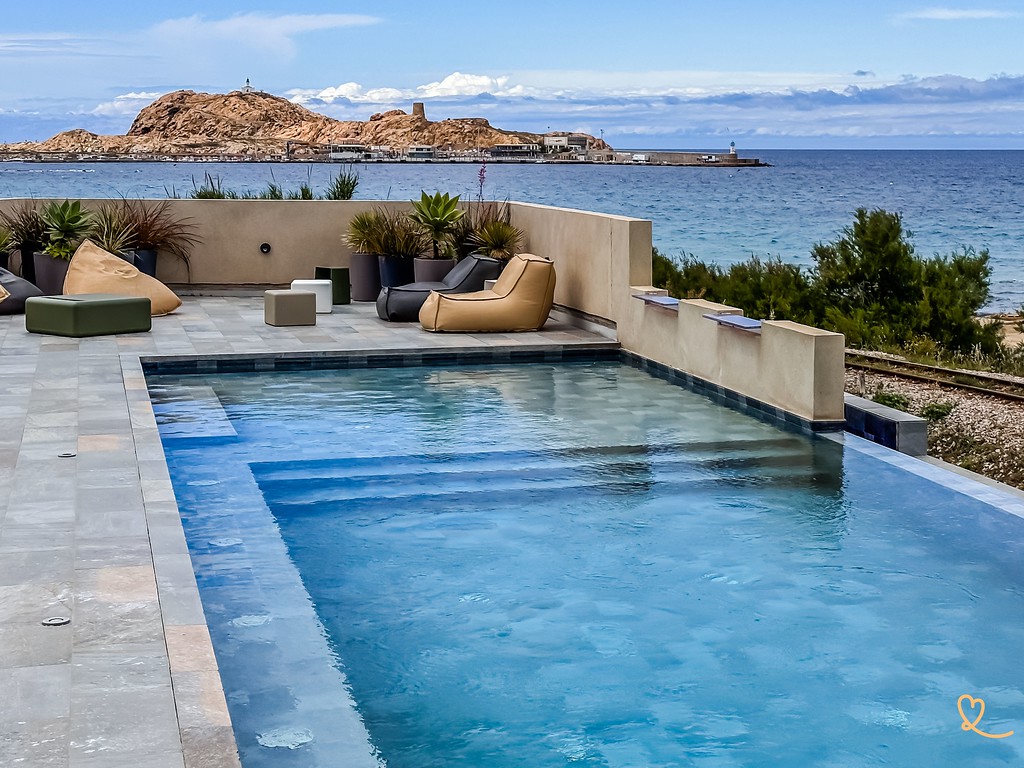
Centrally located in Balagne, with easy access to beaches and inland villages.
See our selection of the best hotels in L’Île-Rousse
or
see the top-rated accommodations in L’Île-Rousse
In Ajaccio

For those looking for the excitement of a big city with museums, restaurants and nightlife.
See our selection of the best hotels in Ajaccio
or
see the best rated accommodations in Ajaccio
In Bonifacio

For those in search of spectacular scenery, and an out-of-the-ordinary stay.
See our selection of the best hotels in Bonifacio
or
see the best rated accommodations in Bonifacio
Where to sleep on the East Coast
In Porto-Vecchio

Direct access to the most beautiful beaches in the south. The town offers many restaurants and a lively nightlife.
Several accommodations along the Palombaggia road allow you to enjoy the beaches from early morning.
See our selection of the best hotels in Porto-Vecchio
or
see the top-rated accommodations in Porto-Vecchio
In Saint-Florent

Strategically located between Cap Corse and the Agriates desert. A quieter atmosphere than in Porto-Vecchio.
See our selection of the best hotels in Saint-Florent
or
see the best rated accommodations in Saint-Florent
In Bastia

Discover an authentic Corsican town with a rich heritage. Convenient point of arrival if arriving by ferry.
See our selection of the best hotels in Bastia
or
see the best rated accommodations in Bastia
How to get to Corsica’s east and west coasts
Both coasts can be reached by plane or ferry.
On the west coast:
- Ajaccio airport (Corsica’s largest)
- Calvi Airport
- Ferries to Ajaccio from Marseille, Toulon and Nice
- Ferries to L’Île-Rousse from Nice and Savona (Italy)

On the east coast:
- Bastia Airport
- Figari airport (for the south)
- Ferries to Bastia from Marseille, Toulon, Nice and several Italian ports
- Ferries to Porto-Vecchio from Marseille and Toulon
Renting a car is essential for exploring the island, whatever coast you choose.
See our article: How to get to Corsica.
HOW TO GET TO Corsica
Option 1: by ferry
Departure from France and Italy
- See all ferry options in our article
- Compare schedules, prices and availability directly
Advantage: you can take your car!

Option 2: by plane
Airports in Bastia, to visit the North, Figari to visit the South, or Ajaccio convenient for all Corsica.
Compare flights!
Frequently asked questions
Which coast to choose for your first holiday in Corsica?
For a first visit, the east coast offers an easier discovery with less demanding roads and a high concentration of beautiful beaches. Porto-Vecchio or Saint-Florent are good bases.
Experienced drivers may prefer the west coast for its more spectacular scenery, bearing in mind that the roads require more attention.
What coastline for a family vacation?
Both coasts are suitable for families, but the east coast has a few advantages: easier roads, sandy beaches with shallow waters (Santa Giulia, Palombaggia), varied accommodation.
On the west coast, Calvi also offers a good compromise with its large beach and numerous services.
Is it possible to combine the two coasts during a holiday?
With at least 10 days, you can stay on both coasts. We recommend two different bases, rather than multiple round trips. For example: 5 days in Calvi to discover the west, then 5 days in Porto-Vecchio for the east.
Crossing the island inland via Corte allows you to discover the Corsican mountains.
Which coast is less frequented?
In high season, both coasts are very busy at the best-known sites. Overall, the east coast around Porto-Vecchio attracts the most tourists.
To avoid the crowds, opt for less famous beaches, visit sites early in the morning or late in the day, and explore the hinterland where you’ll find more peace and quiet.
PLAN YOUR TRIP TO Corsica
Inspiration destinations

Best of
- The most beautiful beaches of Corsica
- The most beautiful villages of Corsica
- The most beautiful cities of Corsica
- The most beautiful destinations in Corsica
- The museums of Corsica
- Hidden gems in Corsica
- The most beautiful natural pools
- What to do in North Corsica
- Best things to do in South Corsica
- Canyoning in Corsica
Where to stay