
Passing through Sartène? Don’t miss the Musée d’Archéologie de la Corse! It offers a fascinating insight into the life and culture of the prehistoric peoples who inhabited the region thousands of years ago. It’s a particularly rewarding complementary visit if you’re planning to discover Corsica’s great megalithic sites such as Filitosa or Cauria.
In this article, you’ll find a selection of useful tips to help you prepare for your visit.
This guide is completely independent, based on our experiences. We visited the region anonymously, making our own choices and paying our bills in full.
Why visit the Corsican Museum of Archaeology?
Is the Corsican Museum of Archaeology worth it? Our opinion:
The Musée d’Archéologie de la Corse is well worth a visit. This is one of Sartène’s best activities. We immersed ourselves in the island’s archaeology, from the earliest recorded settlements (around 10,000 years ago) to the end of the Genoese era in the 15th century. Here you’ll find information on the lifestyles, beliefs and customs of these ancient peoples. It also makes an interesting complementary visit if you plan to explore Corsica’s great megalithic sites such as Filitosa or Cauria.

Our favorite moments
Details of our visit will follow, but we can’t resist sharing our favorite moments with you right now:
- Panoramic views of the Gulf of Valinco and Sartène: the orientation table helps you identify the various points of interest in the landscape.
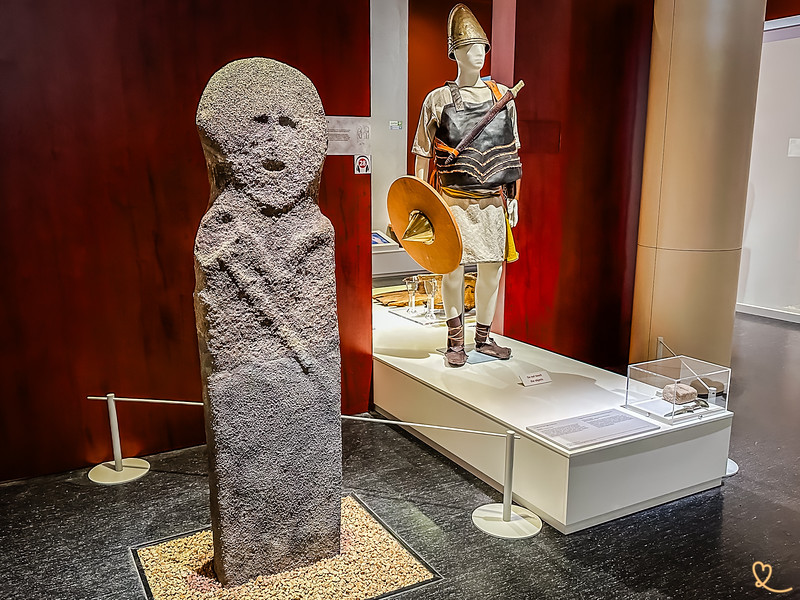
- The collection of statue-menhirs: a jewel in the crown of Corsican and Mediterranean megalithism, these exceptional pieces made a particularly strong impression on us.
- Everyday objects from the period: we loved looking at the flint vases, pendants and arrows that bear witness to the daily lives of ancient populations.

OUTDOOR ACTIVITIES
EN South Corsica
- Sea kayaking under the cliffs of Bonifacio – see options
- Diving – see options
- 4WD tour – see options
- Introduction to canyoning at Pulischellu – see availability
- Complete canyoning experience at Pulischellu – see availability

History in brief
Initially used as a repository for archaeological excavations, the former Sartène prison was converted into a museum in 1977. The space soon became too cramped to accommodate the rich discoveries of the region, one of Corsica’s most densely populated in terms of archaeological sites. The building was then extended: a 1400 m2 extension on 3 levels opened its doors in 2006. Long run by archaeologist and historian Paul Nebbia, the Musée d’Archéologie de la Corse remains a veritable nugget, now under the direction of Laurence Pinet, also an archaeologist.

Access: Corsican Archaeology Museum, Sartène
Where is the Museum of Corsican Archaeology?
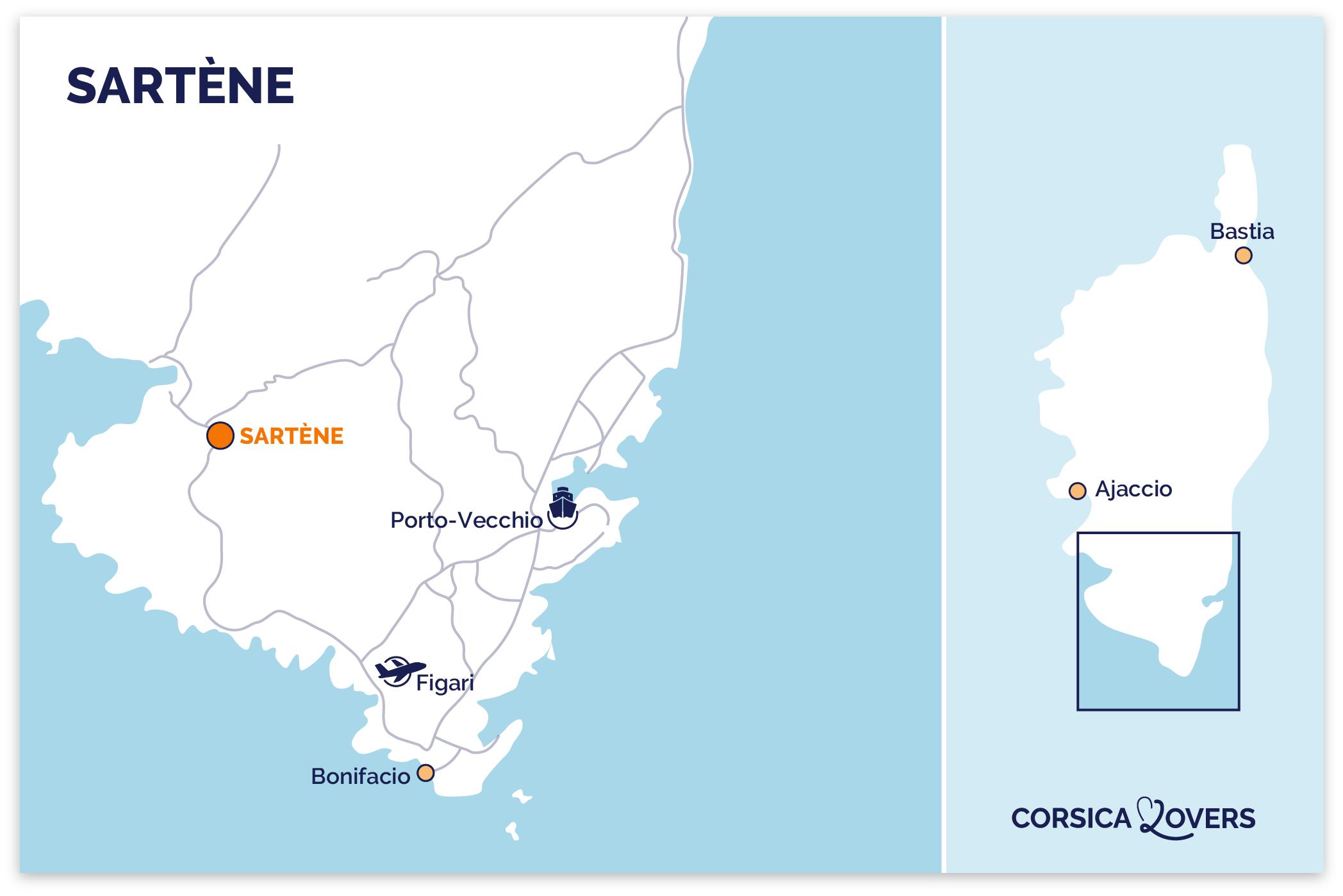
The museum is located on Boulevard Jacques Nicolaï in Sartène, Corse-du-Sud.
- In the heights of the city
- 7-minute walk fromÉglise Sainte-Marie-de-l’Assomption
- 20min drive from Propriano
- 1 hour’s drive from Bonifacio
- 1h30 drive fromAjaccio
- Here’s a map to help you find your way:
OUR TIPS FOR RENTING A CAR IN Corsica
- Compare prices on our preferred platform: DiscoverCars – one of the best rated sites.
- Choose a car that is powerful enough (the roads are steep) but compact (some passages are narrow).
- Remember to take outcomprehensive insurance (some roads are winding and narrow).
- There is a lot of demand, book it early.
How to get there?
If you’re already in Sartène, you can reach the museum on foot from the town center via the pretty, flower-filled staircases.
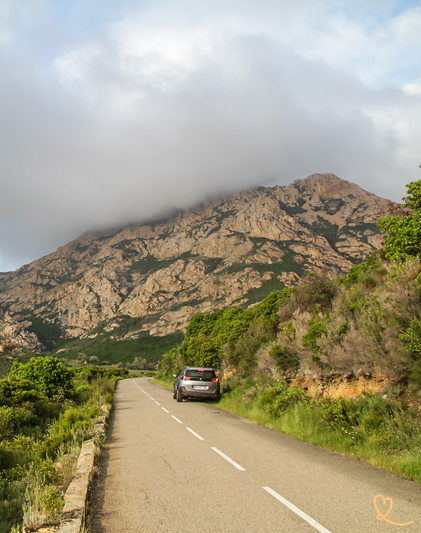
For those arriving from further afield, access by car remains the easiest and most practical way: as Sartène is an isolated town in the Corsican hinterland, we recommend taking the T40 road, which links Bonifacio to Ajaccio.
You can also get there by bus on lines C1 and C3. Please check the timetable before your visit here.

Parking
There is no on-site parking. We recommend the Bassacciu parking lot, which has to be paid for in high season, and is a 10-minute walk up a gentle slope from the museum. Otherwise, you’ll find parking spaces along the road at the entrance to Sartène.
A parking space is reserved for disabled visitors at the front of the museum.

- Canyoning initiation in Pulischellu – see pictures, details and availability
- Complete canyoning experience in Pulischellu – see details and availability
- Or sport canyoning in Purcaraccia – see details and availability
- Via Ferrata near Porto_Vecchio – see photos, details and availability
- Sea kayaking near Propriano (west coast) – see pictures, details and availability
- Sea kayaking under the cliffs of Bonifacio – see pictures, details and availability
Useful tips: duration, schedules, eating…
Best time to visit
We recommend a visit in the low season, as Sartène attracts many tourists in summer thanks to its reputation as the most Corsican of Corsican towns! Overall, the museum remains under-used compared to other sites in the city, as visitors favor outdoor activities. Peak visitor numbers, however, are at midday, when the air-conditioned site is ideal for those seeking a cooler environment. For greater peace and quiet, it’s best to visit in the morning.

Length of visit and main difficulties
Allow 45min to 1h for the visit.
The museum has wheelchair-accessible toilets. An elevator is available on request from reception to bypass the stairs. We noticed that a parking space is reserved for disabled visitors at the front of the museum.

Advice on how to visit
The museography follows a chronological logic. You’ll travel back through the centuries as you visit, with a particular focus on the following periods: Prehistory, the Bronze Age and the Iron Age. On the lower level, you’ll discover a collection of statue-menhirs that particularly impressed us. Before leaving the museum, don’t miss the panoramic view of the Gulf of Valinco, which we found exceptional!

Visiting with children
During our visit, we didn’t notice any facilities particularly suitable for children, apart from the videos on the menhir collection. The museography seemed outdated to us, and could do with a refresh to appeal more to younger visitors.

Schedules and rates
The museum is open:
- June to October, 10 a.m. to 6 p.m.
- April to May Tuesday to Saturday, 10 am to 5 pm
- November to March, Monday to Friday, 9 a.m. to 4 p.m.
Here are the prices:
- Full adult price: €4
- Children under 10 free of charge
For the latest news, visit the official website here.

Catering
If you’ve brought your own packed lunch, you’ll find picnic tables in the immediate vicinity of the museum. A small snack bar is also available on the square. Alternatively, take a look at our selection of good restaurants in Sartène, including Restaurant L’Arbousier for its traditional Corsican cuisine.

Discover the statue-menhirs of Corsica
An exceptional megalithic collection
Since the end of the 5th millennium BC, megalithic manifestations have been an integral part of island culture. The museum houses an important collection of statue-menhirs, anthropomorphic figures emblematic of Corsican and Mediterranean megalithism. Also known as “long standing stones”, or stantari in Corsican, these stone-cut silhouettes reveal an astonishing diversity of shapes and styles. Thanks to videos with headphones and numerous room texts, we were able to explore several of the island’s major archaeological sites and gain a better understanding of this fascinating and distant period.

Remarkable works
We were particularly impressed by the U Nativu statue-menhir, discovered in 1965. It features a massive head with 2 protuberances at ear level and a raised nose and eyebrow block. The Petra Pinzuta statue-menhir stands out in the center of the room. We took a long look at his abstract head, marked by 3 hollows in sub-relief representing the eyes and mouth. These works testify to the artistic refinement and spiritual dimension of Neolithic populations. Take the time to examine the details of these sculptures, which reveal the technical mastery of their creators.

Tracing the history of Corsican settlement
A rich history rooted in the island’s past
Drawing on decades of excavations carried out in the region and throughout the country, the museum offers a clear, well-documented account of Corsican settlement. The Roman period – notably through underwater archaeology – and the Middle Ages are particularly well represented through a wide range of pieces. We enjoyed the diversity of the objects on display: handicrafts, sculpture, ceramics, ammunition… So many vestiges that tell of the commercial and cultural exchanges, but also of the conflicts that have shaped the island’s history. The museum’s presentation is as close as possible to archaeological research, giving us a better understanding of how archaeologists work.

Pieces from another era
Several unique objects caught our eye. Incineration burials from the 6th century BC are impressive for their remarkable state of preservation. Neolithic flint arrowheads testify to the technical know-how of the island’s first inhabitants. Finally, it’s hard not to mention the superb cobalt glass ingots from the Sanguinaires Wreck (3rd century BC). Their intense blue, vibrant despite centuries under the sea, is one of the highlights of our visit. These rare objects open a precious window onto Roman craft practices and trade networks in the Mediterranean.

Contemplate the panorama of Sartène and the Gulf of Valinco
An exceptional view
Located at the top of the old town, in a new building adjoining the former prison, the museum also offers a majestic panorama of Sartène and the valley. We were won over by this view, which is a real bonus to a visit to the museum. An orientation table shows the position of important local landmarks such as theChurch of Sainte-Marie-de-l’Assomption and Piazza Porta, as well as more distant sites such as Filitosa and U Valincu. In the foreground, Sartène’s typical buildings and the church tower stand out against the landscape. On the horizon, the rolling landscape hides the Gulf of Valinco deep in the mountains. Take a moment to enjoy this panoramic view before leaving the museum!

Frequently asked questions
Should you visit Corsican prehistoric sites in addition to the museum?
A visit to the museum is an essential complement to a tour of Corsica’s major megalithic sites, such as Filitosa or Cauria. We recommend that you visit the museum during the warmer hours, to take advantage of an air-conditioned environment, and the sites when it’s cooler.

Does the museum host temporary exhibitions?
Yes, the museum regularly organizes temporary exhibitions. For example, in 2025, the “Cauria sous les étoiles” exhibition featured the incredible photographs of Patrick Nicolaï, offering an artistic look at Corsica’s heritage.
PLAN YOUR TRIP TO Corsica
Inspiration destinations

Best of
- The most beautiful beaches of Corsica
- The most beautiful villages of Corsica
- The most beautiful cities of Corsica
- The most beautiful destinations in Corsica
- The museums of Corsica
- Hidden gems in Corsica
- The most beautiful natural pools
- What to do in North Corsica
- Best things to do in South Corsica
- Canyoning in Corsica
Where to stay