
Are you passionate about prehistory? The Cucuruzzu-Capula Archaeological Site invites you to explore a Bronze Age fortified village nestled in the heart of a forest in the Alta Rocca region of Southern Corsica. We were surprised by the richness of this place, which blends protohistoric remains and medieval ruins along a nature trail.
In this article, check out our photos and all our tips for making the most of your visit to the Cucuruzzu-Capula Archaeological Site!
This guide is completely independent, based on our experiences. We visited the region anonymously, making our own choices and paying our bills in full.
Why Visit Cucuruzzu – Capula?
Cucuruzzu – Is Capula Worth It? Our opinion:
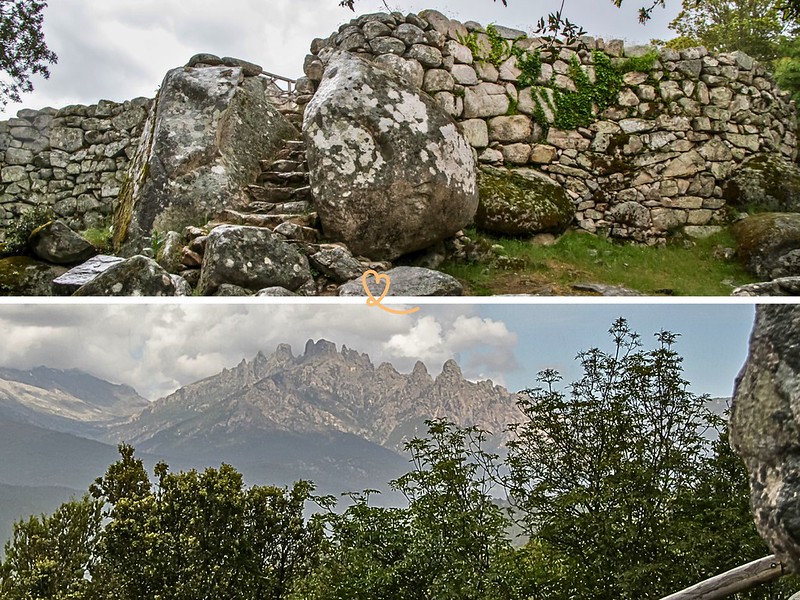
Yes, this archaeological tour is definitely worth the trip! The site features a Bronze Age fortified village, a medieval fortress, and an oak forest dotted with granite boulders. We particularly enjoyed the variety of archaeological remains as well as the panoramic view of the Aiguilles de Bavella from the Castellu de Cucuruzzu.
It is one of the best prehistoric sites in Corsica.
Note that, depending on the document, the name has one or two “c”s: Cucuruzzu or Cuccuruzzu

Our favorite moments
Here are our top 3 highlights from our visit to the site:
- The view from the Castellu de Cucuruzzu, with an unobstructed view of the Pianu di Livia and the Aiguilles de Bavella.
- The discovery of the menhir statue found near the Castellu di Capula, which was reused and then restored on site.
- A walk through the forest between the two casteddi, amid the granite outcrops typical of the plateau.
- It’s one of our favorites in Corsica

WHERE TO STAY IN South Corsica
Option 1: Around the famous beaches
We recommend..:
- Hotel Mariosa with beach and restaurant – see photos and availability
- Résidence U Pirellu, if you want to be able to cook – see photos and availability
- Hotel L’Alivi Santa Giulia with beautiful views over the bay – see photos and availability

Option 2: in the maquis around Bonifacio
We recommend..:
- Hotel Cala di Greco overlooking the citadel! – see prices, pictures and availability
- Hotel A Cheda with its garden and exceptional restaurant – see prices, photos and availability
- Hotel Version Maquis Citadelle (5 stars) – see prices, pictures and availability
Option 3: in Bonifacio itself (citadel or marina)
We recommend..:
- Hotel Spa Genovese in the citadel – see prices, photos and availability
- Hotel Santateresa at the top of the citadel – see prices, pictures and availability
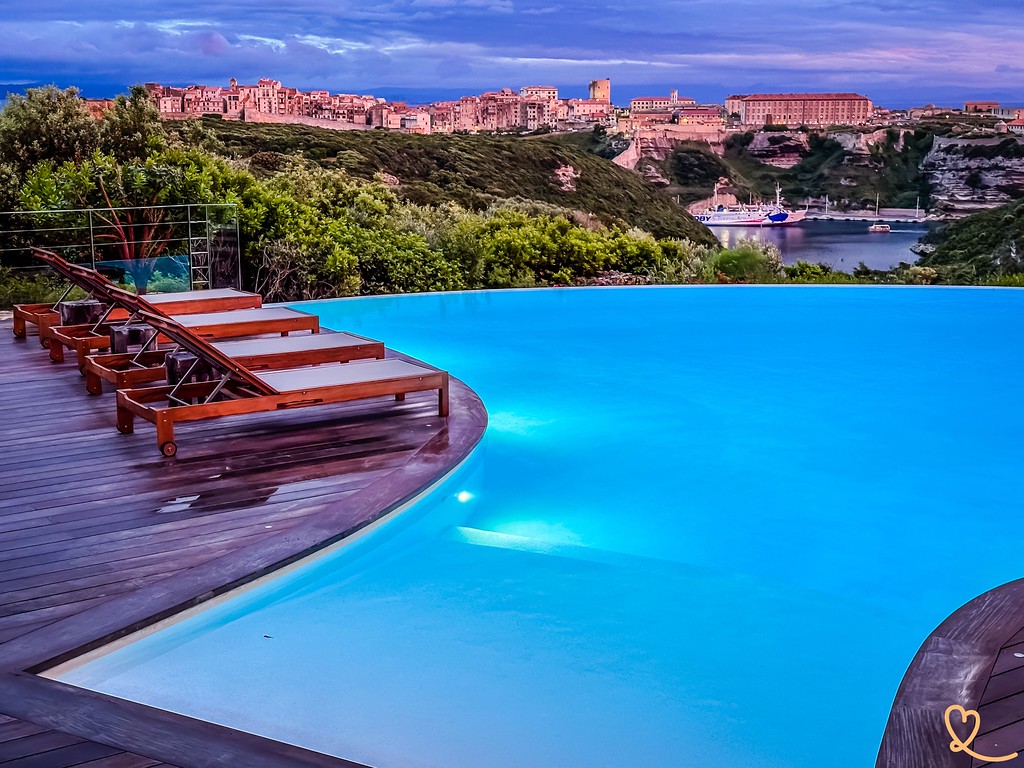
- Hotel Solemare and its swimming pool with view! – see prices, pictures and availability

Option 4: in Propriano
We recommend
- Hotel Aria Marina for convenient apartments with views – see prices, photos and availability
- Hotel Marinca for a little luxury and unforgettable views – see prices, photos and availability


Directions and Map: Cucuruzzu – Capula, Levie
Where is the site?
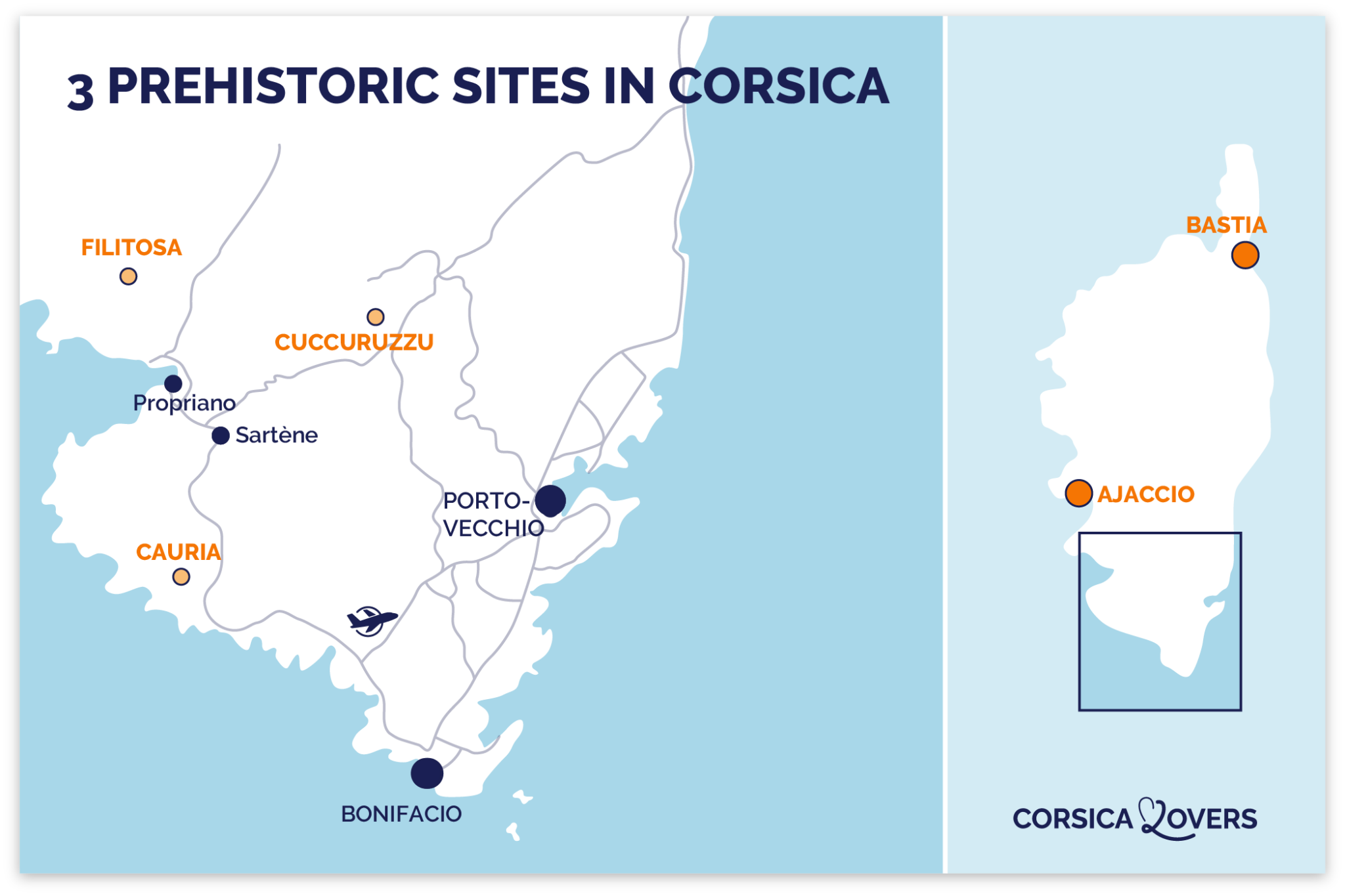
- On the Pianu di Livia, in the municipality of Levie, in Southern Corsica
- Travel time from Levie: about 25 min
- Travel time from Sartène: about 50 minutes
- Travel time from Porto-Vecchio: about 1 hour and 30 minutes
- Here is a map to help you find your way:
How to get there?
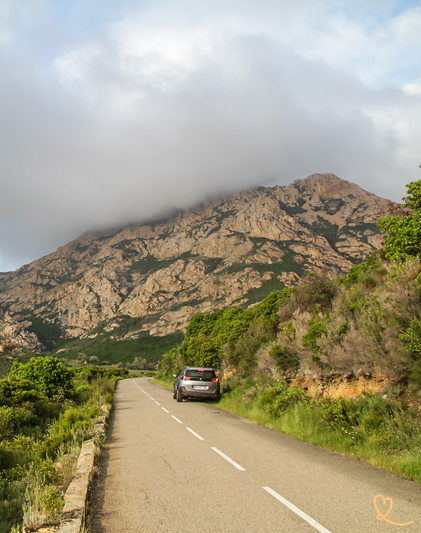
Since the site is isolated in the middle of nature, a car is the only practical way to get there. From Levie, take the D268 toward Sainte-Lucie-de-Tallano, then turn onto a small road that continues for about 4 km to its end, where you’ll find the starting parking lot.
We did not find any bus stops in the immediate vicinity.
Parking
A large parking lot—which, according to our research, is free (to be confirmed)—awaits you at the end of the road, just before the trailhead.

OUR TIPS FOR RENTING A CAR IN Corsica
- Compare prices on our preferred platform: DiscoverCars – one of the best rated sites.
- Choose a car that is powerful enough (the roads are steep) but compact (some passages are narrow).
- Remember to take outcomprehensive insurance (some roads are winding and narrow).
- There is a lot of demand, book it early.
Useful tips: duration, schedules, eating…
Best time to visit
We recommend that you come in the morning, as soon as it opens, to enjoy the trail in peace before the groups arrive. During the summer, the heat can make walking more difficult, even though much of the trail is shaded by trees.
In the spring, some sections of the trail can get wet, so be sure to wear closed-toe shoes that are suitable for occasionally slippery ground.
Length of visit and main difficulties
Allow about 1 hour and 30 minutes for the tour of the site, or up to 2 hours if it’s raining or the ground is slippery. The hike is generally easy, except for a section through a wetland that requires a little more caution.
There are areas with stairs. Caution: The rocks may be slippery.

Advice on how to visit
From the parking lot, a trail through the woods leads you first to the Castellu de Cucuruzzu. Then continue along the trail, which winds through the forest to Castellu di Capula before looping back to the starting point. Let yourself be swept away by the atmosphere of the plateau, surrounded by oak and chestnut trees and granite boulders.

Visiting with children
This nature walk, winding through rocky terrain and past ancient ruins to explore, is perfect for families who enjoy hiking. We did not notice any booklets or special activities for children.
Schedules and rates
- The site is open from April 1 through October 31, during the following hours:
- April, May, October: 9:30 a.m. – 4:00 p.m.
- June through September: 9:30 a.m. – 5:00 p.m. (last admission 2 hours before closing)
- The admission fee is €4 (€3 for reduced-rate tickets).
- Visit the official website for more information here.

Guided tours
The tour is conducted using an audio guide and lasts about 1 hour and 30 minutes (2 hours in case of rain or slippery conditions). This will allow you to proceed at your own pace while learning about the site’s history.
Catering
There are no amenities available along the trail: be sure to bring water with you before you set out. A few kilometers from the site, Auberge A Pignata serves traditional Corsican cuisine, and the restaurant U Spuntinu features a terrace with a magnificent view


Castellu de Cucuruzzu: A Fortified Village from the Bronze Age
As you walk through the Mediterranean forest that overlooks the northern slope of Pianu di Livia, you’ll come across the Castellu de Cucuruzzu, built amid a granite boulder field shaped by Bronze Age people. We enjoyed looking at the terraces and shelters located below, toward the northeast, which once formed a village surrounded by a protective wall—a wall that is no longer accessible.

The site also includes a circular tower 8 meters in diameter, built around 1500 B.C., followed by a monumental complex constructed after its destruction. You’ll be amazed by the scale of this fortified settlement, one of the most iconic sites in the Alta Rocca region.

From its ruins, you can also enjoy magnificent views of the Bavella Peaks and the surrounding mountains.
We loved stopping there to take it all in!

OUTDOOR ACTIVITIES
EN South Corsica
- Sea kayaking under the cliffs of Bonifacio – see options
- Diving – see options
- 4WD tour – see options
- Introduction to canyoning at Pulischellu – see availability
- Complete canyoning experience at Pulischellu – see availability

The Castellu di Capula: From Prehistoric Shelter to Medieval Fortress
A little further up, at an elevation of 759 meters, stands the Castellu di Capula. Built in the 9th century by a man named Bianco, Count of Corsica, it stands on the foundations of an older structure dating from the Bronze and Iron Ages, of which only a surrounding wall remains, partially covered by the medieval construction.
There you will find the menhir statue, which was discovered in the form of two fragments that had been reused to reinforce the medieval staircase, and was later restored and set upright on site. It consists of a nearly rectangular shaft, decorated with a sword in bas-relief on the front, while the spine and ribs are depicted on the back.
Unfortunately, because of the rain, we decided to cut our exploration short.

A walk through the heart of Pianu di Livia
Beyond the archaeological ruins, a visit to Cucuruzzu-Capula is also an invitation to take a walk in the great outdoors. The Pianu di Livia, a vast granite plateau reaching an altitude of around 700 meters, is dotted with rock formations sculpted by erosion, known locally as “taffoni.”

We enjoyed walking beneath the oak and chestnut trees, even wading across a small stream between the two sites. From the Castellu de Cucuruzzu, enjoy the unobstructed view of the plateau and the Aiguilles de Bavella, which stand out against the horizon. This part of the walk struck us as one of the most peaceful moments of the visit.

History
The Castellu de Cucuruzzu is one of about twenty “casteddi” identified in Corsica, most of which are located in the southern part of the island. It bears witness to several millennia of human settlement, spanning from the Bronze Age to the Middle Ages. Here are the key dates to remember:
- Around 1800 B.C.: A protohistoric village was established at the Cucuruzzu site at the beginning of the Bronze Age.
- Around 1500 B.C.: A circular tower (torra) 8 meters in diameter was built on the site.
- After the tower was destroyed, a monumental complex was built on its ruins.
- 9th century: Count Bianco of Corsica had the Castellu di Capula built on the foundations of an older structure dating from the Bronze and Iron Ages.
- 1959: Archaeologist Roger Grosjean mentions the Cucuruzzu site for the first time.
- 1964: François de Lanfranchi resumed his study of the site and continued his research into the 1990s.
- December 1990: The Castellu di Capula was designated a historic monument. New areas were opened to visitors.
- Today, many visitors consider the site to be one of the most important examples of Corsican prehistory.

Frequently asked questions
What is the difference between Cucuruzzu and Capula?
Cucuruzzu and Capula are two separate sites that are part of the same tour route. Castellu de Cucuruzzu is a Bronze Age fortified village, while Castellu di Capula is a 9th-century medieval fortress, built on prehistoric foundations. The tour thus allows visitors to explore several millennia of history in a single walk.
Do I need to wear special shoes to visit the site?
Yes, we recommend closed-toe shoes that are suitable for walking. The trail is generally easy, but one section goes through a wetland, especially in the spring, which can make the ground slippery.
PLAN YOUR TRIP TO Corsica
Inspiration destinations

Best of
- The most beautiful beaches of Corsica
- The most beautiful villages of Corsica
- The most beautiful cities of Corsica
- The most beautiful destinations in Corsica
- The museums of Corsica
- Hidden gems in Corsica
- The most beautiful natural pools
- What to do in North Corsica
- Best things to do in South Corsica
- Canyoning in Corsica
Where to stay