
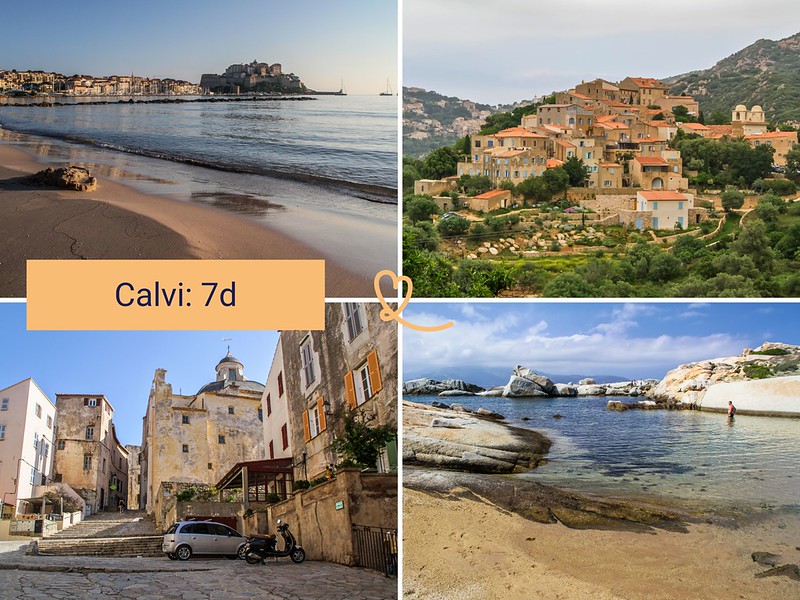
During your week in Calvi, you’ll explore a Genoese citadel perched on a peninsula, a long sandy beach right in the heart of town, hilltop villages, and excursions to UNESCO World Heritage sites.
We’ve explored the region many times, and Calvi is the perfect base from which to explore the entire Balagne region. Here is our itinerary for exploring Calvi and the surrounding area over the course of a week.
This guide is completely independent, based on our experiences. We visited the region anonymously, making our own choices and paying our bills in full.
Practical tips for visiting Calvi in one week
A week in Calvi—is that enough?
A week is a good length of time for Calvi. You can explore the city itself in two days, taking in the citadel, the old town, and the beach. But it’s also a strategic base for the entire Balagne region: hilltop villages, secluded beaches, a trip to Scandola, a day in L’Île-Rousse. Seven days is enough to cover the essentials without ever feeling rushed. If you’re staying for a shorter time, our comprehensive guide to things to do in Calvi will help you decide what to prioritize.

Map of must-see attractions
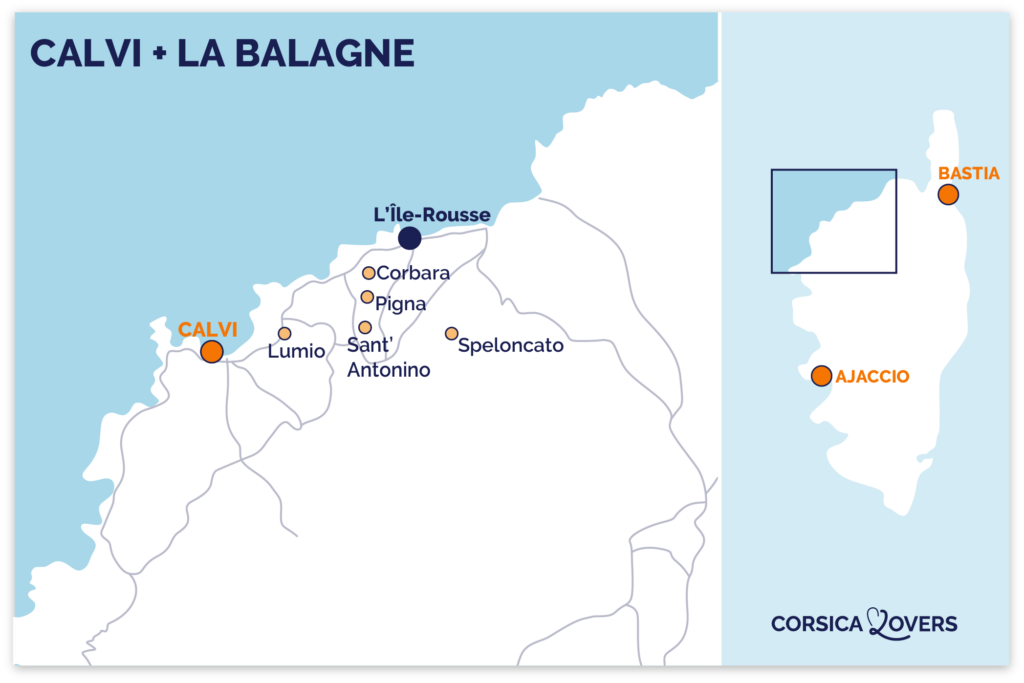
To help you find your way as you read our itinerary, here is a map of the main attractions in Calvi and the Balagne region:
How to get around
A car is essential if you want to visit secluded beaches, hilltop villages, or natural sites in the interior. For travel between Calvi and L’Île-Rousse, the U Trinichellu tourist train is a great option in the summer: it connects the two towns in 45 minutes, runs along the coast for the entire journey, and stops at several beaches along the way.
Where to stay in Calvi
WHERE TO STAY IN Calvi
Our favorites: neighborhoods and hotels
Option1: Around the citadel
Hotel Kasano with its modern decor and beautiful views – see photos and availability
Option 2: Beach side
Hotel Onda with its charming decor – see prices, photos and availability
Option 3: on the heights and in the surrounding villages
Hotel La Villa Calvi, 5 stars – See prices, photos and availability

See all our reviews in our article on the best hotels in Calvi.

Our itinerary: 1 week in Calvi
This itinerary alternates between days spent in the city and days spent on excursions in the surrounding area. We designed the program so that more intense days are followed by quieter ones. If you’d like to create your own course, check out our related articles:
- Best things to do in Calvi
- Most beautiful beaches around Calvi
- Visit the Balagne
- Most beautiful villages of Balagne
Day 1 – The Citadel and Old Town of Calvi
This first day is entirely devoted to Calvi. The city is worth taking the time to explore: each of its neighborhoods has its own unique character, and the sites are well-connected for walking.
Morning – View from Notre-Dame de la Serra
To kick off your trip, start by getting a bird’s-eye view. Notre-Dame de la Serra is a chapel perched on the hills overlooking Calvi, whose terrace offers a panoramic view of the bay, the citadel, and the peaks in the background. Built in the 15th century, it is surrounded by scrubland and rocky outcrops characteristic of the Corsican landscape.

We recommend heading up there first thing in the morning, when the light is still soft and the trails are quiet. It’s about a 30-minute walk from downtown, or just a few minutes by car to the parking lot located right below the chapel.
Midday – The Old Town and the Covered Market
Once you’re back in town, spend the rest of the morning exploring the lower town. The old town of Calvi stretches out at the foot of the citadel and along the marina; it is also known as the lower town. Its narrow streets are lined with shops, studios, cafés, and restaurants. Georges Clemenceau Street is the liveliest: it is closed to traffic in the summer. The morning market is a great place to start if you want to explore the region’s cheeses and cold cuts.

Highlights not to be missed include the salt tower built in 1495, Louis Patriarche’s statue of the water carrier, and the bust of Christopher Columbus beneath the ramparts. According to local legend, the navigator was born in Calvi, although the story remains a matter of debate. The Baroque-style Church of Santa Maria Maggiore is recognizable by its pink façade.
Afternoon – The narrow streets of the Citadel
The Citadel of Calvi is the city’s must-see attraction. Built under Genoese rule between 1483 and the 17th century to strengthen the coastal defenses, it occupies the entire peninsula and overlooks the bay from its imposing ramparts. Inside, a maze of cobblestone alleys, stairways, and courtyards leads up to the highest vantage points, where the view takes in the beach, the mountains, and, on a clear day, Monte Cinto, which rises to 2,706 meters.

We’ve spent many hours exploring this site, and every visit reveals new hidden corners. Some of the must-see sights include: the Church of Saint John the Baptist, the Oratory of Saint Anthony, and the MUDACC—the Citadel Art Museum, which features works from the Contemporary Art Collection.
Warning: The ground is covered with uneven pavement, and there are many slopes. We do not recommend this tour for people who have difficulty walking. Be sure to wear appropriate footwear. To find out more, read our article dedicated to the Citadelle of Calvi.
End of the day – The beach or the Pinède promenade
La Pinède Beach stretches for 5 km right in the heart of Calvi. It offers a rare combination of attractions: clear water, views of the citadel from the shore, mountains in the background, and a row of pine trees that provide shade. We recommend visiting in the late afternoon, when the soft light illuminates the ramparts and the crowds have thinned out. The atmosphere is more relaxed then, perfect for a first walk along the water. For more details, see our article on Calvi’s main beach.

But if you’d still like to go for a walk, you can also enjoy the path that runs along this beach and the pine trees, as well as the railroad tracks.

Day 2 – Village and beach, peaceful
Morning – The artisan village of Pigna
Located 35 minutes from Calvi, Pigna stands out from the other villages in Balagne for its artistic character. Potters, luthiers, and engravers work in studios that open onto the street, where their creations are on display and available for purchase. The uniform blue shutters on all the facades give the village a distinctive visual cohesion.

The place is clearly a tourist spot, especially in July and August, but that doesn’t make it any less interesting. We loved the lively atmosphere of the place: it’s not a museum village, but a place where artisans are still actively at work.
Please arrive before 10 a.m. to find a parking spot.
For more information, check out our article on Pigna.
Afternoon – Bodri and Ghjunchitu beaches
Bodri is located 30 minutes from Calvi and just 10 minutes from L’Île-Rousse. This white-sand beach, set in unspoilt natural surroundings, is one of our favorites in the Balagne region. Parking is paid during the summer, but you can also get there by train. From the parking lot, it’s a 5-minute walk to the water.

A 10-minute stroll through the Mediterranean maquis then leads to the nearby Ghjunchitu beach, whose sand is reputed to be among the finest in Corsica. We recommend walking there and back so you can enjoy the coastal trail. For more practical information, check out our article on Bodri and Ghjunchitu.
OUR TIPS FOR RENTING A CAR IN Corsica
- Compare prices on our preferred platform: DiscoverCars – one of the best rated sites.
- Choose a car that is powerful enough (the roads are steep) but compact (some passages are narrow).
- Remember to take outcomprehensive insurance (some roads are winding and narrow).
- There is a lot of demand, book it early.
Day 3 – Excursion: Scandola and the calanques de Piana
This day is one of the highlights of the trip. The Scandola Nature Reserve and the calanques de Piana, located in the Gulf of Porto in southern Balagne, form a UNESCO World Heritage Site. The red and pink porphyry cliffs plunge straight into the sea. The caves carved out by the waves, the geological formations, and the crystal-clear water combine to create a landscape unlike any other in the Mediterranean.

We’ve visited these sites several times, and the effect is as striking as ever. Access is restricted: Scandola is a protected nature reserve, and the only way to reach it is by boat. The most convenient option from Calvi is to book a boat tour — see available options.
To find out more about the site, see our guide to the Gulf of Porto.
Day 4 – L’Île-Rousse by train
Today, leave the car behind and take the U Trinichellu tourist train from Calvi. It connects the two cities in 45 minutes, runs along the coast the entire way, and stops near several beaches. It’s a pleasant way to get to L’Île-Rousse while enjoying the scenery from the seaside.
Morning – The Market and the Old Town
L’Île-Rousse is a town with a character quite different from that of Calvi. Founded in 1758 by the Corsican leader Pasquale Paoli, it was built from the ground up to serve as a port independent of the Genoese. Its grid-like layout, straight streets, and uniform architecture from the late 18th and early 19th centuries give it a rational appearance, quite different from the medieval villages in the interior.

The covered market, located right in the center, is bustling in the morning and brings together local farmers and artisans. We appreciate the laid-back atmosphere of this town: less crowded than Calvi, it’s easier to get around on a day-to-day basis. To find out all you need to know about the town, read our guide to visiting L’Île-Rousse.
Afternoon – Pietra Islands and the Lighthouse
The Pietra Islands Promenade is the highlight of L’Île-Rousse. It starts at the waterfront and stretches all the way to the top of the lighthouse, perched on the red porphyry islets that gave the city its name. These copper-colored rock formations, characteristic of the local geology, are the destination’s main visual feature.

The colors are particularly vivid at the beginning or end of the day, when the low light accentuates the contrasts. We’ve walked this path at different times of day, and it never gets old. If you’d like to learn more about the route, check out our article on the Pietra Islands.
USE OUR GUIDE TO PLAN A
DREAM TRIP TO Corsica
All the information you need for your trip:
- 7 maps that make planning easier
- 130+ pre-selected locations
- Practical advice
- + 220 photos to help you choose
Day 5 – Village and Beach, Other Styles
Morning – Sant’Antonino and Speloncato
The morning is devoted to two of Balagne’s oldest villages. Sant’Antonino, whose origins date back to the 9th century, is considered one of the oldest villages in Corsica. Perched at an altitude of 500 meters, it towers over everything around it. Its houses, built close together, form a maze of narrow alleys designed to facilitate defense against attackers: the geography of the place was a fortress in itself.

Speloncato, built on a rocky spur at 570m, is less touristy and offers remarkable views of the sea and hills. We really liked the way the rock is an integral part of the village’s architecture. We recommend setting aside at least two hours to explore these two sites, which are about a 20-minute drive apart. For more information, check out our articles on Sant’Antonino and Speloncato.

Afternoon – Punta di Spanu
Punta di Spanu is a 25-minute drive from Calvi, at the far end of the bay. This place is unlike any ordinary beach: there are two small sandy areas, but it’s the presence of giant boulders that really sets it apart.

These formations plunge into water of astonishing clarity and offer numerous opportunities for exploration: coves, passages between the rocks, and the Genoise Tower. We count Punta di Spanu among our favorite spots in Corsica. The road gets rough over the last few miles: drive slowly. For more details, see our article on Punta di Spanu.
Afternoon, Option B – Sainte-Restitude Beach or Arinella Beach
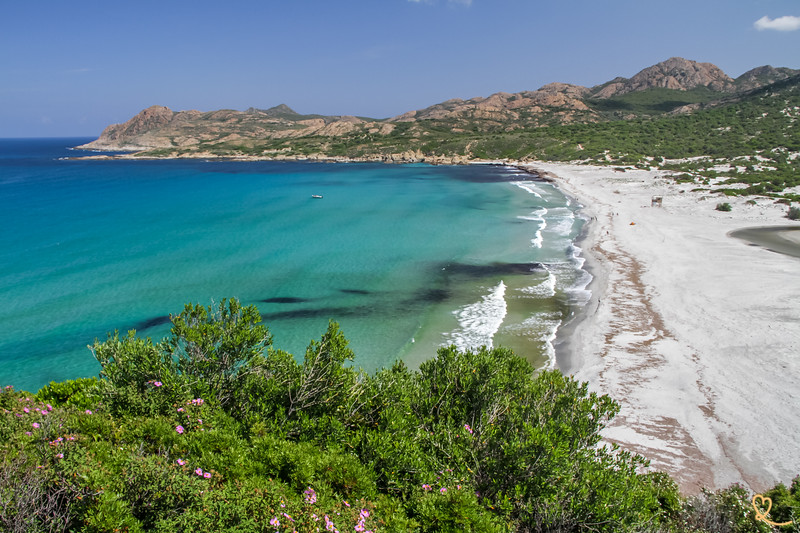
For the afternoon, two sandy beaches located between Calvi and Lumio offer different options, with more amenities than Punto di Spanu. Sainte-Restitude Beach, located 20 minutes from Calvi, is a 150-meter-long cove lined with rocks, with a gentle slope into the water—a plus for families. It faces the citadel, offering interesting views of the site from the shore.

A little further north, Arinella Lumio Beach offers a similar setting: it is unsupervised and rockier at the edges. We like these two places because they’re relatively quiet outside of peak season. Be careful not to confuse Arinella in Lumio with the beach of the same name in Bastia.
HOW TO GET TO Corsica

Option 1: by ferry
Departure from France and Italy
- See all ferry options in our article
- Compare schedules, prices and availability directly
Advantage: you can take your car!

Option 2: by plane
Airports in Bastia, to visit the North, Figari to visit the South, or Ajaccio convenient for all Corsica.
Compare flights!
Day 6 – Out in nature
On this sixth day, we’ll head away from the coast to discover another side of the region: its hills, forests, and coastal trails. Two options to choose from, depending on your preferences.
Option A – The Revellata Peninsula
South of Calvi, the Revellata Peninsula juts out into the sea, set against a wild backdrop. You can drive to a large parking lot at the base of the cliff, from where you can either follow the Sentier des Douaniers on foot or explore the rocks, streams, and turquoise waters that line the coast.

The entire loop to the tip of the peninsula takes about 2½ hours and offers views of the Calvi citadel along the way. It is also a great spot for diving, particularly thanks to the wreck of an American B-17 bomber lying at a depth of 28 meters in the bay. For a trial dive, check availability.
Option B – The Bonifato Forest and the Fango Valley
The Bonifato Forest, located 20 km above Calvi, is surrounded by steep cliffs that form a unique natural amphitheater. You can go hiking or climbing there, or join a section of the GR20 trail, not to mention the natural pools hidden among the rocks, which are perfect for a dip in fresh water.

Further west, the Fango Valley stretches through the heart of the Corsica Regional Nature Park. With its crystal-clear rivers and dense forests, it offers a walking experience quite different from that of the coast. We found the valley to be particularly well-suited for families and beginner hikers.
Day 7 – Agriates Desert or a day at the beach
Option A – The Agriates Desert and Saleccia beach
The Agriates Desert is a protected area in northern Balagne, a rocky landscape of scrubland that opens onto some of Corsica’s most remote beaches—which explains why they remain so unspoiled. Saleccia Beach, the best-known beach in the area, features white sand and turquoise waters in a location that is difficult to reach except by boat or 4WD.

From Calvi, the most convenient option is to book an organized tour— see the itinerary and availability. You can also drive to Saint-Florent (1 hour and 40 minutes) and then take the boat. We recommend an early start: the distances are long and the beach is well worth the time. For more information, see our guide to the Agriates Desert.
Option B – More beach
You can round out your stay with a relaxing day on Calvi’s long beach, with views of the mountains and the citadel.

Option 1 – For hikers
The region offers a variety of trails, from the coast to the foothills of the GR20. Here are the itineraries that made the biggest impression on us:
- The Pointe de la Revellata Trail — a 3.5-hour loop, less than 10 km, with views of the citadel, the cliffs, and rare wildlife.
- Exploring the abandoned village of Occi from Lumio—a short walk, a unique atmosphere.
- The Candia Loop in the Bonifato Forest — 2 hours, easy, natural pools.
- The coastal trail between Algajola and Punta di Spanu — 4.5 hours for the entire route or just a section.
- The hike from L’Île-Rousse to Monticello (8 km) — suitable for all, with views of the bay.
- The Fango Valley — several marked trails in the heart of the regional nature park, with remarkable biodiversity.
Before each trip, check for fire risks and weather conditions: conditions can change quickly in the summer.

Option 2 – For water sports enthusiasts
The Bay of Calvi and the seabed off the Balagne coast offer a wide range of activities. Diving is one of the most accessible activities here: the wreck of a B-17 bomber lying at a depth of 28 meters in the bay attracts experienced divers, while beginners can opt for a guided introductory dive— check availability. In addition, the Fango River and the inland gorges offer opportunities for canyoning, via ferrata, and rafting for those looking for more intense activities.

OUTDOOR ACTIVITIES
AT North Corsica
- Introduction to diving – see options
- Snokeling trip – see options + availability
- Quad between sea and mountains – see photos + availability
- Canyoning – see options
- 4WD tour – see options

Option 3: Saleccia Park
Spend a relaxing moment surrounded by nature.
The Parc de Saleccia is a magnificent garden with Corsican flora: maquis, pines, myrtles and fig trees, and several types of olive trees.
Latest news on the official website here.

What You Need to Know for Your Stay in Calvi
Weather and best time to visit
Temperatures in Calvi are pleasant from April through October. Spring is the perfect time for hiking and exploring villages: the light is crisp, accommodations are available, and the sites are much less crowded. Summer is hot—sometimes very hot—and swimming is best between mid-June and mid-September. In July and August, Calvi’s main beach is very crowded. Fall is a good compromise: the sea stays warm, the foliage changes color, and the atmosphere becomes more peaceful. The winter is mild, but many businesses close between November and March.
We’ve found that May and September offer the best balance between thermal comfort and peace and quiet. For outdoor activities, check the local weather forecast before each outing: thunderstorms can develop quickly in the mountains.
Parking in Calvi
There is a paid parking lot at the foot of the citadel—the Christophe Colomb Parking Lot. It gets crowded quickly in the summer: arrive early. La Pinède Beach has the La Pinède Parking Lot, which offers shaded parking and charges a fee from April through October. There are no free daytime parking zones in the city center. There are secondary parking lots located 5 to 10 minutes’ walk from the city center, allowing you to park your car without having to go near the citadel.

Where to eat in Calvi
The city offers a wide variety of dining options, from restaurants along the marina to more local spots. Among our recommendations:
- A Casetta Restaurant — for beautiful platters of Corsican charcuterie, this is a sure bet.
- Il Capitano Restaurant — if you’re looking for more sophisticated cuisine paired with a view from the 5th-floor terrace, this is a great option.
- Vie Marine Restaurant — a charming spot overlooking the harbor, serving creative cuisine: prawns with soy caramel and citrus, pork tenderloin with wildflower honey…
PLAN YOUR TRIP TO Corsica
Inspiration destinations

Best of
- The most beautiful beaches of Corsica
- The most beautiful villages of Corsica
- The most beautiful cities of Corsica
- The most beautiful destinations in Corsica
- The museums of Corsica
- Hidden gems in Corsica
- The most beautiful natural pools
- What to do in North Corsica
- Best things to do in South Corsica
- Canyoning in Corsica
Where to stay