
With a week in Balagne, you can alternate between sandy beaches, Genoese villages perched on their rocky spurs, boat excursions to listed nature reserves and hikes in unspoilt forests.
We’ve been to this region several times, and each visit reveals something new: here’s our ideal itinerary for visiting Balagne in 1 week.

This guide is completely independent, based on our experiences. We visited the region anonymously, making our own choices and paying our bills in full.
Practical tips for visiting Balagne in 1 week
What can you see in Balagne in 1 week? Is it long enough?
A week is the ideal length of time to explore the Balagne region without rushing: you can visit its two major towns, discover a few hilltop villages, enjoy the best beaches and take an excursion to the Scandola nature reserve. More than enough to fill seven days!

Map of must-see attractions
To help you find your way around our itinerary below, here’s our map of the main tourist attractions in Balagne:

Getting around Balagne
A car is essential to reach most of the hilltop villages, isolated beaches and natural sites inland. Between Calvi and L’Île-Rousse, the U Trinichellu tourist train is a welcome alternative in summer: it links the two towns in 45 minutes, skirting the coast along the way and stopping at several beaches.
See the cars and offers available on our favorite platform.
Where to sleep in Balagne
WHERE TO STAY IN Balagne
Option 1: Île-Rousse
We recommend..:
- Hotel Rocabella, with Jacuzzis – see prices, pictures and availability
- Hotel Saletta Mare, aparthotel with a superb swimming pool – see prices, photos and availability
- See our article on the best hotels in L’Île-Rousse

Option 2: Calvi
We recommend..:
- Hotel Kasano with its modern decor and beautiful views – see photos and availability
- Hotel Onda with its charming decor – see prices, photos and availability
- See our article on the best hotels in Calvi

Option 3: in the villages of Balagne
We recommend..:
- Hotel A Casa di Ma in the charming village of Lumio with its Michelin-starred restaurant –see prices, photos and availability
- Hotel Serenada in the seaside village of Agajola – see prices, photos and availability

Our ideal itinerary: 1 week in Balagne
We’ve created this itinerary to discover every aspect of the region, alternating quieter days with more intense ones.
If you’d like to create your own itinerary, take a look at our dedicated articles:
Day 1 – Calvi: the heights, the citadel and the beach
Morning – Panorama from Notre Dame de la Serra
To kick off your stay in the Balagne region, there’s nothing like a first panorama in the fresh air. Notre Dame de la Serra is a chapel perched high above Calvi, whose terrace offers a 360° view of the bay, the citadel and the peaks that close in on the horizon. We recommend you climb it in the morning, when the light is still soft and the trails are less busy. It’s a 30-minute walk from the town center, or a short drive to the parking lot just below the chapel. This visit gives us an idea of the landscape that awaits us for the week.

Afternoon – The narrow streets of Calvi’s Citadel
After lunch, head for the Citadel, built under the Genoese government between 1483 and the 17th century to reinforce the city’s defenses. It dominates the entire peninsula, surrounded by imposing ramparts. We spent several hours wandering its narrow streets, each visit revealing new nooks and crannies, old stones gilded by the sun, sudden openings to the sea between two walls.
The atmosphere is particularly calm outside rush hour. Please note that the ground is covered with uneven pavement and that there are many slopes: we do not recommend this visit to people with walking difficulties. To find out more, read our article dedicated to the Citadelle of Calvi.

End of the day – La Pinède beach
To round off your first day, head for La Pinède beach, a huge arch of white sand stretching 5km right in the heart of Calvi. We recommend a visit at the end of the day, when the low-angled light illuminates the citadel at the end of the bay and the atmosphere becomes more relaxed. The pine trees lining the beach provide shade and a pleasant setting for a stroll along the water’s edge. More photos in our article on Calvi’s main beach.

Day 2 – Excursion: Scandola and calanques de Piana
This is one of the most spectacular days of the trip. The Scandola nature reserve and the calanques de Piana in the Gulf of Porto, south of the Balagne region, are both UNESCO World Heritage sites. The pink and red cliffs plunging into the sea, the caves carved out by the waves and the absolute transparency of the water make up a landscape unrivalled in the Mediterranean.
We’ve visited these sites several times, and the effect is as striking as ever. The most practical option from Calvi is to book a boat trip: see options.
To find out more about the site, see our guide to the Gulf of Porto.

HOW TO GET TO Corsica

Departure from France and Italy
- See all ferry options in our article
- Compare schedules, prices and availability directly
Advantage: you can take your car!

Airports in Bastia, to visit the North, Figari to visit the South, or Ajaccio convenient for all Corsica.
Compare flights!
Day 3 – Village and beach
Morning – The artisan village of Pigna
Pigna is one of Balagne’s most representative villages, perched on a hill overlooking Corbara and the sea. What sets it apart from its neighbors is its artistic vocation: potters, luthiers and engravers work in workshops open to the street, where you can watch them at work and buy their creations directly. The blue shutters on all facades lend a distinctive visual coherence to the whole.
We suggest you arrive in the morning to enjoy the atmosphere before the influx of visitors. We appreciated the lively character of the place, even if the tourist presence is quite noticeable in high season. To extend your visit, see our article on Pigna.

Afternoon – Bodri and Ghjunchitu beaches
Bodri is 30 minutes from Calvi and just 10 minutes from L’Île-Rousse. This white-sand beach, set in unspoilt natural surroundings, is one of our favorites in the Balagne region. Parking is charged in summer, but can also be reached by train. From the parking lot, it’s a 5-minute walk to the water.
A 10-minute stroll through the Mediterranean maquis then leads to the nearby Ghjunchitu beach, whose sand is reputed to be among the finest in Corsica. We recommend that you walk there and back to enjoy the coastal path. For more practical information, see our article on Bodri and Ghjunchitu.

Day 4 – In the wild
This day is intentionally quieter: after the sea excursion of Day 2 and the miles of sand of the previous day, Balagne also invites you to hike and swim in the river. Two sites stand out for this open-air day.
The Bonifato forest, 20km above Calvi, is encircled by sheer cliffs that make it a natural cirque in its own right. Here you can hike, fish, climb or join a section of the GR20, not forgetting the natural pools hidden between the rocks, ideal for a refreshing swim.
The Fango Valley lies at the heart of Corsica’s regional nature park. Its crystal-clear rivers, dense forests and remarkable biodiversity make it a very different place to walk from the coast. We found the valley particularly suitable for families and novice walkers.

Day 5 – L’Île-Rousse
Morning – Discovering L’Île-Rousse
L’Île-Rousse is very different from Calvi in spirit. Founded in 1758 by Corsican leader Pasquale Paoli as an independent port from the Genoese, it features straight streets and homogeneous architecture typical of the late 18th and early 19th centuries. Covered market, church, pedestrian streets and a sandy beach right in the center of town make up a program that can be done entirely on foot.
We recommend you start at the market to get a feel for the local rhythm, then walk along the seafront to the beach. We love the gentle way of life in this town: it’s less crowded than Calvi and, in our opinion, more appealing on a day-to-day basis. If you want to avoid the car for the day, the U Trinichellu train runs from Calvi to L’Île-Rousse along the coast in 45 minutes. To find out all you need to know about the town, read our guide to visiting L’Île-Rousse.

Afternoon – Walk to the Pietra Islands and the lighthouse
In the afternoon, devote your time to the Pietra Islands promenade, the real highlight of L’Île-Rousse. The walk begins on the waterfront and stretches to the top of the lighthouse, perched on the red porphyry islets that give the town its name. These copper-hued rock formations form the visual heart of the destination.
Colors are particularly striking at the beginning or end of the day, when low light accentuates contrasts. We’ve taken this walk at different times and it never tires. If you’d like to find out more about the route, see our article on the Pietra Islands.

Day 6 – Perched villages and wild coastline
Morning – Sant’Antonino and Speloncato
The morning is devoted to two of Balagne’s oldest villages. Sant’Antonino, whose origins date back to the 9th century, is considered one of Corsica’s oldest villages. Perched at an altitude of 500m, it dominates its surroundings. Its tightly-packed houses form a maze of narrow alleyways, designed to facilitate defense against attackers: the geography of the place was in itself a fortress.

Speloncato, built on a rocky spur at 570m, is less touristy and offers remarkable views of the sea and hills. We loved the way the rock is an integral part of the village’s architecture. We recommend that you allow at least two hours to explore these two sites, which are about twenty minutes apart by car. To find out more, read our articles on Sant’Antonino and Speloncato.

Afternoon – Punta di Spanu
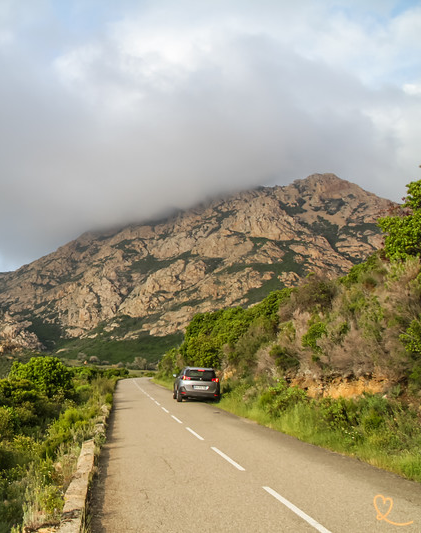
Punta di Spanu is a 20-minute drive from Calvi. The road deteriorates over the last few kilometers, so drive slowly. This is not a classic beach: there are two small sandy areas, but it’s the presence of giant boulders that gives the place its character. These formations protrude into astonishingly clear water, offering numerous opportunities for exploration.
Punta di Spanu is one of our favorite spots in Corsica, so different is its atmosphere from the usual beaches. For more photos and practical details, see our article on Punta di Spanu or our selection of the most beautiful places in Corsica. We recommend that you spend the late afternoon swimming and relaxing before returning to Calvi or L’Île-Rousse for dinner.

OUR TIPS FOR RENTING A CAR IN Corsica
- Compare prices on our preferred platform: DiscoverCars – one of the best rated sites.
- Choose a car that is powerful enough (the roads are steep) but compact (some passages are narrow).
- Remember to take outcomprehensive insurance (some roads are winding and narrow).
- There is a lot of demand, book it early.
Day 7 – Agriates Desert or more beaches
Option A – The Agriates Desert and Saleccia beach
The Désert des Agriates is a protected area north of Balagne, covering wild rocky terrain opening onto some of Corsica’s least accessible beaches – which explains their unspoilt beauty. Saleccia beach, the most famous in the area, combines white sand and turquoise water in a setting that few places in the Mediterranean can match.
To reach it from Calvi, you have two options: drive to Saint-Florent (1h40) and take the boat followed by a walk, or book a 4WD excursion directly from Calvi – see program and availability. Along the way, you’ll cross the Ostriconi region, whose beach is one of the most beautiful in Corsica. We recommend an early start: the distances are long and the beach is well worth the time. For more information, see our guide to the Agriates Desert.

Option B – Villages and beaches at your own pace
If the Agriates Desert seems too ambitious for the seventh day, this final day is an opportunity to revisit your favorites or discover sites that the itinerary didn’t have time to cover. The Balagne region still boasts many interesting villages: Lumio, Corbara, Algajola… As for beaches, Arinella, Sant’Ambroggio and Plage de la Sainte-Restitude are less popular options than Bodri or Calvi beach. Take a look at our selection of the most beautiful villages in Balagne and our guide to the most beautiful beaches in Balagne to put together your own program.

Alternative 1: For hikers
Balagne is a richer hiking destination than it first appears.
- The pointe de la Revelatta, south of Calvi, offers a 2h30 loop through the wilderness to the tip of the peninsula.
- The hike from L’Île-Rousse to Monticello (8km) is accessible to all levels and offers beautiful views over the bay.
- The ascent of Monte Sant’Angelo from Corbara (1h30) is more demanding, but rewards you with an extensive panorama of the region.
- In the Bonifato forest, 20km from Calvi, you can tackle a section of the GR20 and bathe in its natural pools.
- Last but not least, the Fango Valley offers several signposted trails in the heart of the regional nature park, in an environment of high biodiversity.
- We appreciated the diversity of these options: in Balagne, you can go from the seaside to the Corsican mountains in just a few kilometers.

Alternative 2: Saleccia Park
Spend a relaxing moment surrounded by nature.
The Parc de Saleccia is a magnificent garden with Corsican flora: maquis, pines, myrtles and fig trees, and several types of olive trees.
Latest news on the official website here.

Alternative 3: For village lovers
The main itinerary covers Pigna, Sant’Antonino and Speloncato, but the Balagne also boasts many villages well worth a visit. Algajola, on the seafront between Calvi and L’Île-Rousse, charms with its ramparts, quiet streets and position right on the beach.
Corbara and Monticello offer extensive coastal views in a less crowded atmosphere. Even more discreet, Muro, Feliceto, Nessa and Belgodère retain their authentic character and typical stone architecture. We refer you to our complete guide to the most beautiful villages of Balagne to build your own itinerary according to your interests.

What you need to know for your stay in Balagne
Weather and crowds in Balagne
Temperatures in Balagne are pleasant from April to October. Spring is ideal for hiking and exploring the villages: the light is clear, accommodation is available and the sites are seldom visited. Summer is hot, sometimes very hot, and swimming is at its best between mid-June and mid-October. In July and August, visitor numbers increase considerably, especially on the beaches of Calvi and L’Île-Rousse. Autumn offers a good compromise: the sea is still warm, the vegetation is brighter and accommodation is easier to find.
Winter is mild, but many establishments close between November and March, reducing dining and accommodation options. We’ve found that May and September offer the best balance between thermal comfort and peace and quiet. We recommend that you consult your local weather forecast before planning your outdoor activities.
THE BEST OF THE Balagne
Discover our articles on the region:

Discover our articles about L’Île-Rousse:

Discover our articles on Calvi: